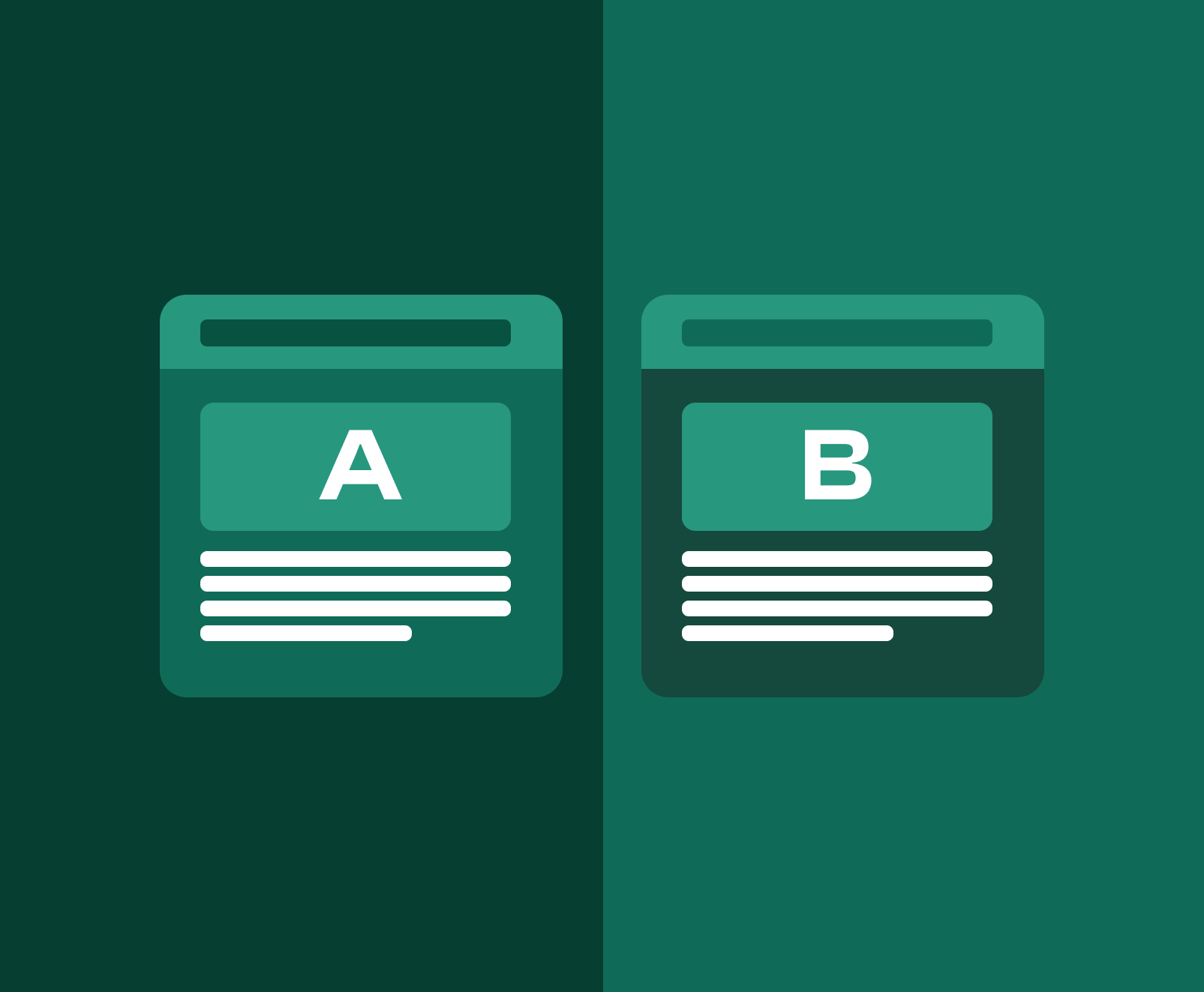
What is A/B testing
A/B testing is a controlled experiment where two versions of a webpage, element, or experience are shown to different users to measure which version performs better. One version acts as the control, while the other introduces a single change. Performance is evaluated using metrics like conversions, engagement, or revenue.
A/B testing isolates cause and effect. The test determines whether a specific change directly influences user behavior rather than relying on assumptions or opinions.
What Is the goal of A/B testing?
The goal of A/B testing is to improve the tracked metrics by validating decisions with data and determine a clear winner between both tested variations. A/B testing reduces risk by supporting subjective design or marketing choices with data.
A/B testing helps teams increase conversion rates, improve usability, and maximize the return on existing traffic.
What should you A/B test?
You should A/B test things like headings, calls to action, layouts, pricing presentation, and even forms. By A/B testing things like this, you focus on elements that directly influence user decisions. Pages with meaningful traffic and clear conversion actions are the highest priority. Each test should change one variable so results remain interpretable.
When should you A/B test?
You should A/B test when your content receives enough traffic volume, and you want to improve your conversion rates. Testing without enough traffic will produce noise rather than insight.
A/B testing is best used before major redesigns, during optimization cycles, or when performance plateaus.
Examples of A/B Testing
Homepage headline split tests
Homepage headline tests compare messaging clarity and value propositions. These tests determine which headline better communicates relevance and intent to first-time visitors. Studies show that when you customize headlines especially to a user’s locale, conversions increase, so ensuring your messaging is dialed in is very important.
CTA button copy split tests
A/B testing CTA copy measures how language affects conversions. Small wording changes can significantly impact click-through and conversion rates.
Landing page layout split tests
Landing page layout tests evaluate information hierarchy and visual flow. These tests reveal whether users understand the page faster or convert with less friction. They’ll also help you identify sticking points or friction so you can remove, restructure, or redesign them to see positive trends in consumption and conversion.
Pricing page structure split tests
Pricing page structure tests assess how plans, features, and comparisons are presented. The goal is to reduce hesitation and guide confident decisions.
Form length split tests
Form length tests help you determine how much data you can collect from users without causing them to stop partway through. A/B testing here is one of the best ways to collect the most data possible without harming conversions.
Navigation label split tests
Split testing navigation labels help you examine how users interpret menu language. Clear labels improve discoverability and reduce cognitive load. The less confusing you can make your users, the more time they’ll spend on your website.
Hero image split tests
A/B testing high-performing pages to see which hero image performs best can be a great way to measure emotional response and perceived credibility. Visual context can reinforce or weaken the message above the fold.
Redesign split tests
A/B testing major website redesigns is vital, as you can validate major visual or structural changes incrementally to ensure you only see improvements in conversions. Testing prevents full launches based on assumptions and protects performance during transitions.
How To Implement A/B testing
A/B testing implementation begins with a hypothesis tied to a measurable outcome. The hypothesis defines what is changing and why the change should affect behavior.
Traffic is split randomly between variations to avoid bias. This split is usually 50/50. The test runs until sufficient data is collected to support a statistically valid conclusion. No changes should be made mid-test or you risk corrupting the data collected by the testing process.
A/B Testing Analysis
Once your A/B testing is complete, you can run through the data to determine which variant has the best outcome. Once you determine which variant has pulled ahead during split testing, you can then implement that change on the website permanently, and you can do so with 100% confidence, as your users have shown it to be the superior variation.
Then you can make another change and run tests on it as well. This type of analytical approach helps you ensure each incremental change made will improve the website’s ability to convert users into paying customers.
A/B FAQ
What is a minimum sample size for A/B testing
The minimum sample size depends on baseline conversion rate, industry, website type, expected lift, and desired confidence level. Tests without sufficient sample sizes produce unreliable conclusions.
Sample size should be calculated before the test begins to avoid premature decisions. Many modern A/B tools like VWO will help you determine when you have received enough data to make an accurate decision.
How long should an A/B test run?
An A/B test should run long enough to capture normal traffic patterns, including weekdays and weekends. Most tests require at least one full business cycle.
Tests should not be stopped early based on partial results, as early trends often reverse based on industry-specific business cycles.
What is the difference between A/B testing and Multivariate testing?
A/B testing compares two versions with a single variable changed. Multivariate testing evaluates multiple variables simultaneously.
A/B testing is simpler, faster, and easier to interpret. Multivariate testing requires significantly more traffic and complex analysis.
A/B Testing & SEO
A/B testing does not harm SEO when implemented correctly. Search engines can handle temporary variations when canonical URLs and indexing rules are properly managed.
SEO-safe A/B testing avoids cloaking, preserves crawlable content, and limits test duration. Testing user experience improvements often supports long-term SEO performance.
Implemting A/B Testing On Your Website
Implementing A/B testing on a website requires technical precision and strategic restraint. Tests should align with business goals, user intent, and long-term growth rather than short-term wins.
If your website is underperforming or preparing for a redesign, structured splita testing will ensure changes are validated before implementation. For businesses looking to improve conversions through design and performance, our web design services include thorough A/B testing implementation and analysis. If you’re wanting to improve your website’s conversions by leaning on actual user-verified data, give us a call.