Understanding Technical SEO
SEO
Technical
This article explains how Google extracts facts from content, why clarity matters at the sentence level, and how fact structure influences SEO outcomes.
Fact extraction systems analyze documents to identify statements that express a single, verifiable idea. These statements are evaluated based on structure, clarity, and contextual consistency. Sentences that clearly express one relationship are more likely to be extracted than sentences that bundle multiple ideas together.
Many of these systems represent facts internally as structured relationships. One common representation is a subject–attribute–object triple, where a concept is linked to a specific property or meaning.
For example, the sentence “A 302 status code indicates a temporary redirect” can be represented as: A [302 status code: subject] - [indicates: attribute] - [a temporary redirect: object].
This structure makes the fact easy to extract, validate, and reuse because the subject is explicit, the relationship is clear, and the meaning does not depend on surrounding sentences. Instead, it is a self-contained matter-of-fact statement that can be easily extracted and utilized by search.
Search engines rely on extracted facts to support passage ranking, answer generation, and result synthesis. Pages that consistently express clear facts are easier to trust and easier to position correctly within a topic graph.
When multiple pages express similar facts with similar clarity, search engines may test different URLs for the same query. This is one of the primary causes of cannibalization. Clear fact ownership reduces ambiguity by signaling which page is responsible for which class of facts.
SEO strategy, in this context, becomes less about keyword placement and more about controlling which page asserts which facts.
Fact extraction systems prefer sentences that make one clear claim at a time. When a sentence contains multiple clauses or multiple claims, it becomes harder to represent as a single structured fact. Writing one idea per sentence increases extraction confidence and reduces ambiguity.
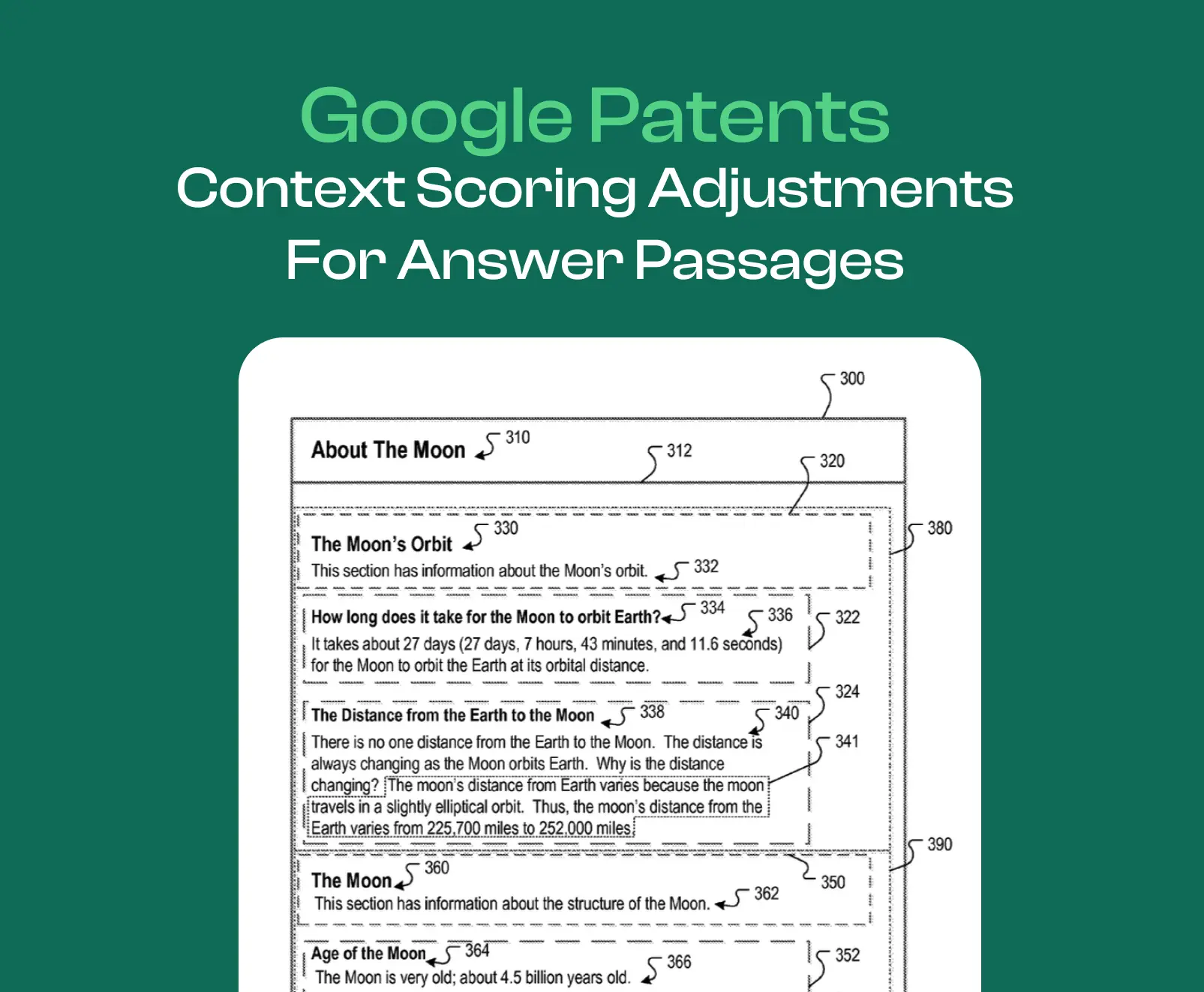
Dedicate each section to a specific claim. Your heading should outline the claim made in the section. The paragraphs that are direct descendants of your heading should consist of two parts. You should have an anchor sentence that makes the primary claim of the section. Then, all other sentences should support and verify your anchor sentence.
Patents show that pronouns require additional interpretation and reduce confidence during extraction. Repeating the subject makes each sentence self-contained and easier to evaluate. A sentence that names the concept directly is more reliable than one that relies on previous context.
Headings provide context for the facts that follow. Declarative headings reinforce the scope of extracted facts and help prevent misclassification of your anchoring statements and all context that follows. A heading should state what the section asserts, not suggest what it might discuss.
Verbs such as is, indicates, refers to, and represents create stable relationships between concepts. These verbs appear frequently in high-confidence extracted facts because they clearly describe how two ideas are related.
Use predicates that directly relate to your specific context to improve extraction. Various patents mention that there are whole databases dedicated to categorizing predicates based on different contexts. Certain predicates are used commonly in one industry, whereas those same predicates will never be used in other contexts. Understanding which predicates perfectly map to your context will help you create solid subject attribute/predicate object triples. Ensuring quality SAO/SPO triples will directly improve extractability.
System-level facts describe an entire concept. Component-level facts describe parts within that system. Mixing these on the same page creates scope fragmentation. Keeping them separate clarifies authority and prevents overlap with related pages. If you must touch on a different level fact, do so briefly and within a paragraph, not a heading. Abiding by this will prevent cannibalization.
Fact extraction systems prefer explicit statements that can be evaluated directly. Rewriting questions as declarative sentences increases extractability. Implied claims and rhetorical questions can not be easily interpreted without expensive algorithmic processes. Improve extractability and ranking potential by being straightforward and explicit.
Facts placed early within a section benefit from stronger contextual signals and less competing information. Leading with the primary assertion ensures that the most important facts are extracted even if later content becomes more complex. In addition you will make it easier to write quality extractable because your anchor is established first. With your anchor established clearly, you can then use that as a reference to create sentences that support and verify your anchor statement.
Extracted facts may be reused independently of the original document. Writing sentences that make sense on their own increases the likelihood that they are selected, scored, and reused accurately.
Content prepared for fact extraction prioritizes clarity and structural consistency. Each page should assert a small, well-defined set of facts, express them explicitly, and avoid resolving concepts that belong to other pages.
Maintaining this level of precision becomes difficult as content scales. Over time, pages accumulate overlapping assertions and blurred scope, which makes it harder for search engines to assign authority consistently. If you want help improving and maintaining your extractability, check out our SEO services to reduce keyword cannibalization, improve topical authority, and more.